What is a Shaft Seal?
As is well known, the shaft seal is one of the main components of centrifugal pumps. Except for magnetically coupled (sealless) pumps, its use is mandatory in all centrifugal pumps. In this article, we will try to share with you the types of shaft seals and their working mechanics.
The basic function of the shaft seal in a centrifugal pump is to provide sealing between the wet and dry zones of the pump. The wet zone is the pump casing side, where the fluid is pressurized and mechanical energy is converted into hydraulic energy. The dry zone, on the other hand, is the shaft, bearings and motor side, which lies outside the wet zone.
In order to better understand the function and working principle of the shaft seal, it is useful to briefly touch upon the working logic of the centrifugal pump.
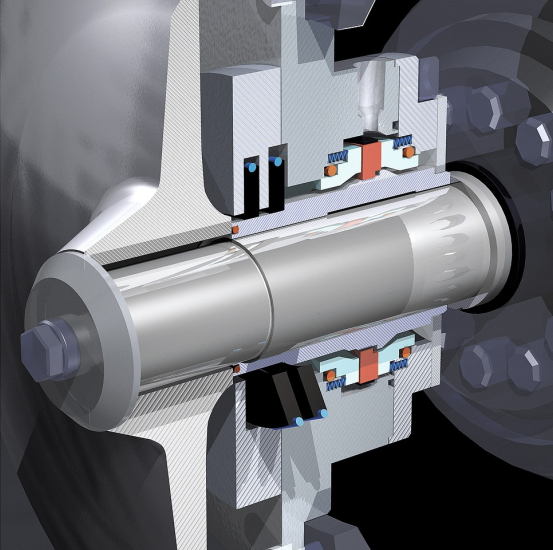
First, the motor, located in the dry zone, draws energy from the mains, converts electrical energy into mechanical energy, and transmits this energy to the pump shaft via the coupling. One end of the shaft is connected to the coupling side, i.e. the dry zone, while the other end is connected to the impeller in the pump casing, which we call the wet zone. In this way, the shaft rotates the impeller inside the casing. The impeller, in turn, pressurizes the fluid through its vanes, converting mechanical energy into hydraulic energy.
Looking at this working mechanism, the fundamental sealing problem arises from the fact that part of the shaft is dry while part of it is located in the wet zone (creating an opening in the pump casing), and at the same time the shaft is a moving, i.e. rotating, element. We can devise two different solutions to prevent fluid from leaking out of the casing. The first solution is to drive the pump impeller by a method other than a shaft connected to the motor; in this case, using a magnetically coupled pump would be appropriate. The other solution would be to use an additional element that both allows the shaft to rotate and minimizes leakage from the pump casing. This element is precisely what we call the shaft seal.
Today, the most widely used types of shaft seal are the mechanical seal and soft packing. Although each type has its own advantages and disadvantages, as industrial production quality increases, the rate of use of mechanical seals is also increasing. The reason for this will become apparent shortly, when we explain how both types of seal work.
Soft Packing
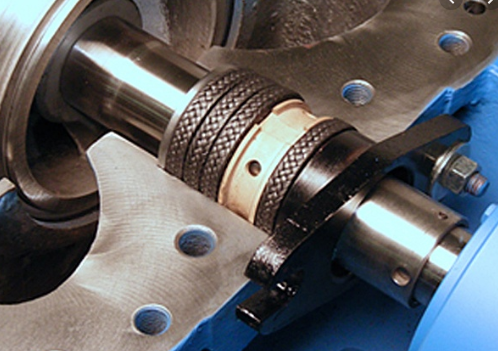
Soft packing can be described as a component that provides sealing by physically filling the gap between the shaft and the casing mentioned above. Soft packing rings are wound around the shaft — or around a sleeve fitted onto the shaft to protect it from wear — in a varying number of turns. This both provides sealing and allows the shaft to rotate. However, it should not be forgotten that soft packing never provides complete sealing, and in fact it is not even desirable for it to do so. This is because, due to the continuously generated friction force, the packing heats up and surface friction increases. For this reason, there must always be fluid present at the packing, both to cool it and to somewhat reduce the friction. Although the amount of this leakage is theoretically stated as 1-2 drops per minute, field observations have shown that even in the best systems this figure is 5 to 10 drops per minute. This leakage amount is adjusted using the packing gland (compression) element found on the pump.
Mechanical Seal
Mechanical seals are used for exactly the same purpose, but their working system is quite different. Mechanical seals consist of two parts: a stationary element and a rotating element. The stationary element is mounted on the pump and does not move. The rotating element, on the other hand, is mounted on the shaft or on a sleeve fitted onto the shaft, and rotates in synchronization with the shaft.
The working system of the mechanical seal is as follows: as fluid passes through the pump, the stationary element on the casing side (in the high-pressure zone) is pushed toward the rotating element on the motor side due to fluid pressure. A spring located on the rotating side enables this movement and supports the rotating seal face. In this way, the faces of the rotating and stationary elements almost adhere to each other. However, since one side is continuously rotating while the other remains continuously stationary, if these faces were to fully adhere to each other, the faces would quickly wear and fracture due to friction, rendering the seal unable to perform its function. For this reason, a very small gap forms between the faces of the stationary and rotating elements. This gap is approximately 0.0008 mm in size. The fluid pumped fills this gap and forms a very thin film layer between the two faces.
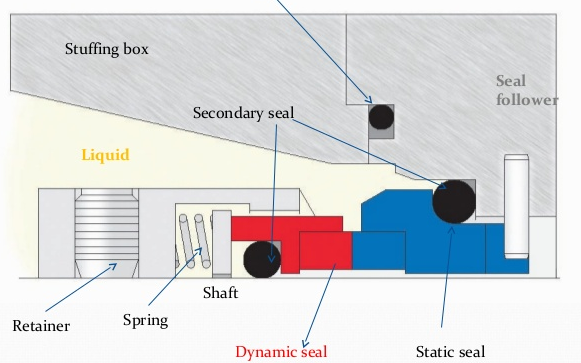
Since there are numerous articles, videos and animations on the working principle of the mechanical seal, we have summarized the topic briefly here. If you would like to examine the working logic in detail or ask a question, you can contact us.
Soft Packing or Mechanical Seal?
Both types of seal have their own advantages and disadvantages. What must be taken into account when choosing a seal is the needs of the system and the facility. For example, if an expensive fluid is being transferred, it would be appropriate to use a mechanical seal in order to reduce leakage to zero. Likewise, if the fluid being pumped poses a risk to human health and the environment, and zero leakage is again required for this reason, a mechanical seal is the most correct choice. However, in an environment where the loads placed on the pump are high, or where there are frequent small-scale movements in the ground the pump is seated on, soft packing will be more suitable to use, as it can tolerate axial misalignment much better.
| Mechanical Seal | Soft Packing | |
| Advantages (+) |
||
| Provides Near-100% Sealing | Price advantage | |
| Does Not Require Much Maintenance | Ease of Installation | |
| Long Service Life | High Tolerance for Axial Misalignment | |
| Disadvantages (-) |
||
| Prices Are High | Requires More Maintenance | |
| Installation Is More Difficult. | Cannot Provide 100% Sealing | |
| Very Low Tolerance for Axial Misalignment. | Damages the Shaft or Sleeve in a Short Time | |
The advantages and disadvantages of mechanical and soft packing seal types are briefly summarized above. However, it must be remembered that the most correct choice on this matter will be made by pump manufacturers. This is because the seal type is a component that must be selected taking into account the fluid, the system in which the pump is located, and the pump's own construction. At the same time, pump manufacturers are likely familiar with the field and environmental conditions for which a selection is being made, and they have pumps already operating in such systems. For this reason, they will also recommend the most suitable seal based on experience.