Coupling Adjustment and Correct Alignment in Centrifugal Pumps
KSB and other manufacturers mostly deliver the pump mounted on a baseplate, with the electric motor connection already made via a coupling. However, the vibrations that occur during transport and installation of the pump in its final position disturb the alignment of this equipment. For this reason, the coupling must be adjusted again once the pump installation and grouting have been completed in accordance with the specified requirements. In addition, realignment is required whenever the pump or motor is moved or repositioned, whether for maintenance or any other reason.
What do we mean by 'alignment'?In coupled pumps, the power taken from the motor is transmitted to the pump shaft via a coupling. Under ideal conditions, these two shafts (the pump shaft and the motor shaft) should be exactly parallel and have the same centerline. Flexible couplings can tolerate small alignment errors, but for ideal, trouble-free operation, it must be ensured that these two shafts are aligned within the tolerances specified by their manufacturers.
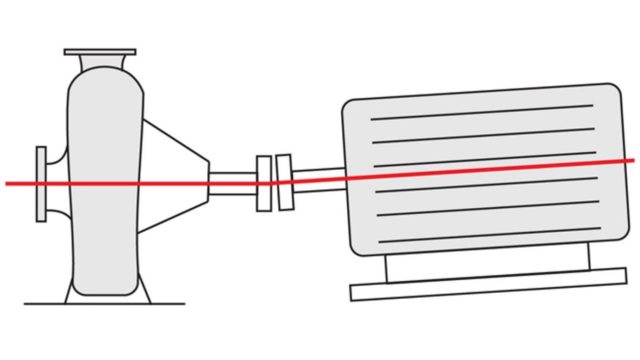
There are two types of misalignment that can cause operational problems. The first of these, angular misalignment (Angular Misalignment), occurs when the centerlines of the motor shaft and the pump shaft are at an angle to each other, as shown below.
parallel misalignment, on the other hand, is the situation in which the pump and motor shafts are parallel, but their centerlines are located at different positions relative to each other, either vertically or horizontally.
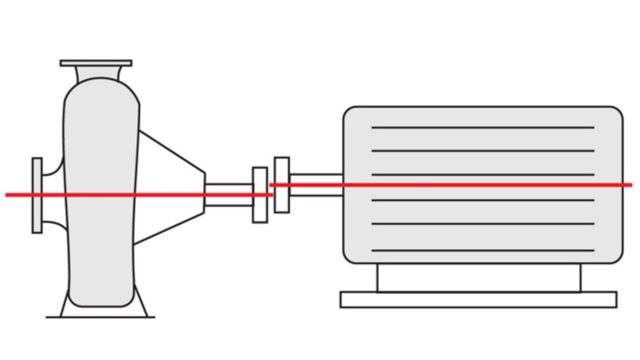
In pumps where coupling alignment has not been performed, or has been performed incorrectly, both types of misalignment are generally observed together.
Measuring Alignment The first step in properly aligning motors and pumps is to measure the degree of misalignment.
A simple procedure for angular alignments is as follows:
- With the motor and pump shaft flanges close to each other but not connected, mark a point on each shaft and then measure the distance between them with a feeler or taper gauge.
- Keeping the marks close to each other, rotate both shafts approximately 90 degrees. Measure the separation distance again. Repeat for 180 and 270 degrees.
- If the measured separation remains the same as the shafts are rotated, they can be assumed to be parallel. However, differences in the measured flange separation indicate that the shafts are not perfectly aligned.
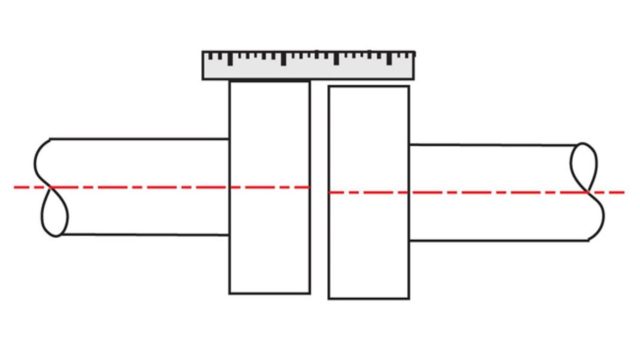
A similar procedure can be used to measure parallel alignment. Here, a straightedge is placed on one of the flanges, and the distance to the other flange is measured (as shown below).
Laser measuring devices are generally used for alignment between motor and pump shafts. Laser alignment devices provide a higher level of accuracy.
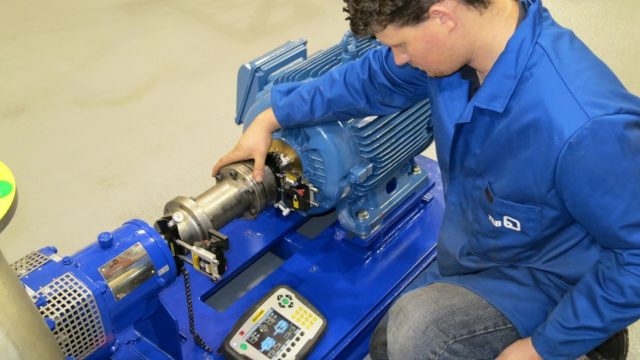
Checking alignment with laser measuring equipment
Correcting Misalignment
Since pumps are generally connected to the line, it is easier to move the motor. Small adjustments to the motor position in the horizontal plane are generally made by loosening the motor anchor bolts, shifting the motor sideways, and then retightening the bolts. Vertical adjustments are generally made by adjusting leveling screws or by adding or removing shims under the motor feet. Care should be taken in shim selection. A few relatively thick shims are preferred over a set of thin shims, because thicker shims generally provide firmer and more secure support for the motor. Naturally, whenever the pump or motor is repositioned, the alignment must be checked again.
Soft Foot Problems
Bent, damaged or poorly mounted bases, incorrectly selected shims, or loose anchor bolts can all lead to a condition known as soft or spongy foot. When this occurs, it will be very difficult, if not impossible, to properly align rotating machinery. Even if everything looks fine while the pump is not running, operating loads — including motor torque and thermal stresses — can throw everything out once the pump starts running. Modern laser coupling alignment devices can help detect foot problems by measuring small changes in the position of the pump and motor.